

 Tiếng Việt
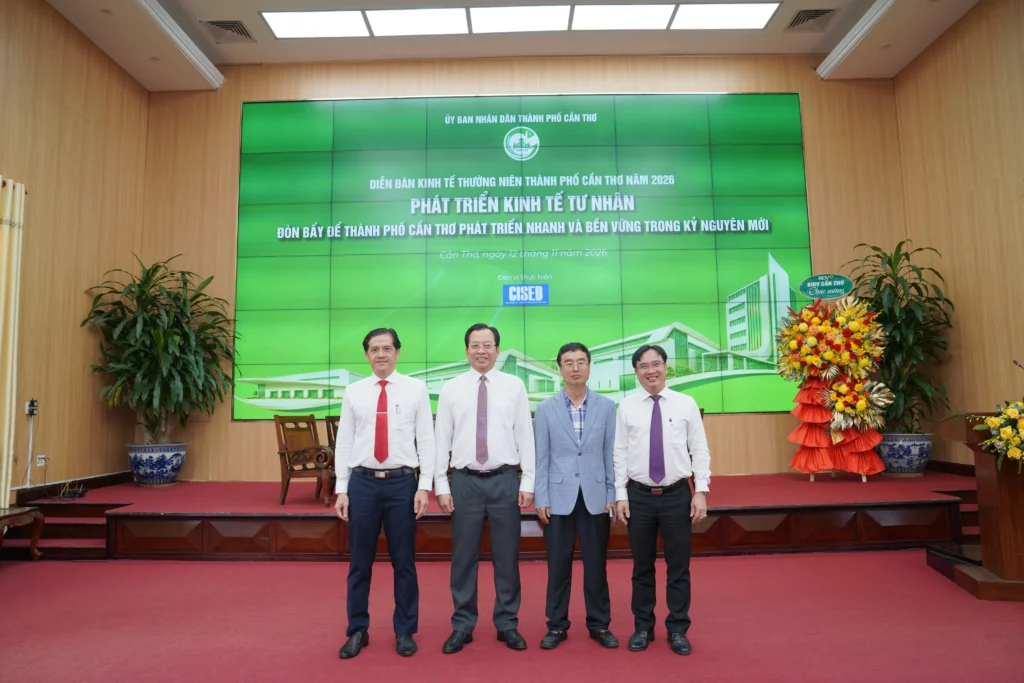
On the morning of November 12, 2026, the 2026 Can Tho City Annual Economic Forum, themed “Private Sector Development – A Driving Force for Can Tho City’s Rapid and Sustainable Growth in the New Era” took place, attracting considerable attention from experts, policymakers, business leaders, and the business community. At the forum, Prof. Vo Xuan Vinh – Director of the Institute of Business Research, University of Economics Ho Chi Minh City (UEH) – presented a paper analyzing the current state, identifying key bottlenecks, and proposing development orientations for the private economic sector in Can Tho City for the 2026-2030 period.
The Private Sector’s Important Role in Can Tho’s Economic Growth
According to Prof. Vo Xuan Vinh, the private sector plays a particularly important role in Can Tho City’s economic growth. Despite its significant contribution to the local economy, private enterprises continue to face limitations in business performance and operational efficiency. In addition, the business landscape remains structurally unbalanced in terms of enterprise size. Small and micro-sized enterprises account for the overwhelming majority, while large enterprises represent only a very small proportion of the total number of businesses in Can Tho.
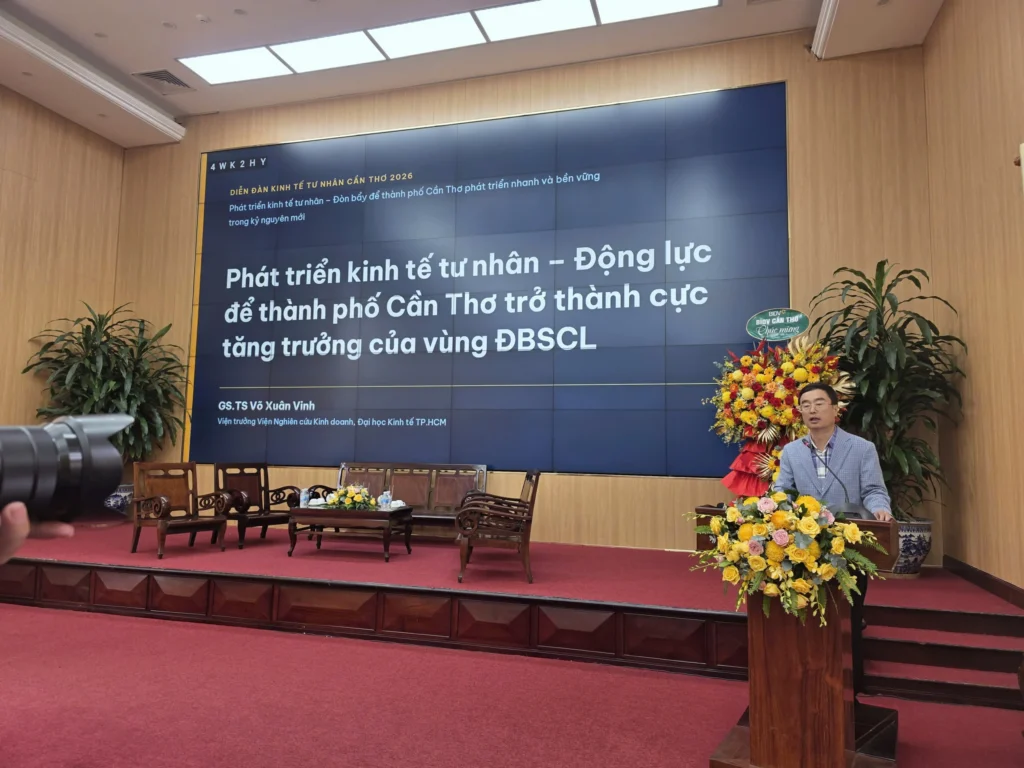
Prof. Vo Xuan Vinh analyzes the role of the private sector in Can Tho City’s economic development.
According to him, the shortage of medium-sized and large enterprises is one of the key constraints on the formation of production networks and the integration of local businesses into the value chains of major corporations.
Four Key Bottlenecks in Private Sector Development
Based on his assessment of the current situation, Prof. Vo Xuan Vinh identified four major bottlenecks affecting the development capacity of the private sector in Can Tho.
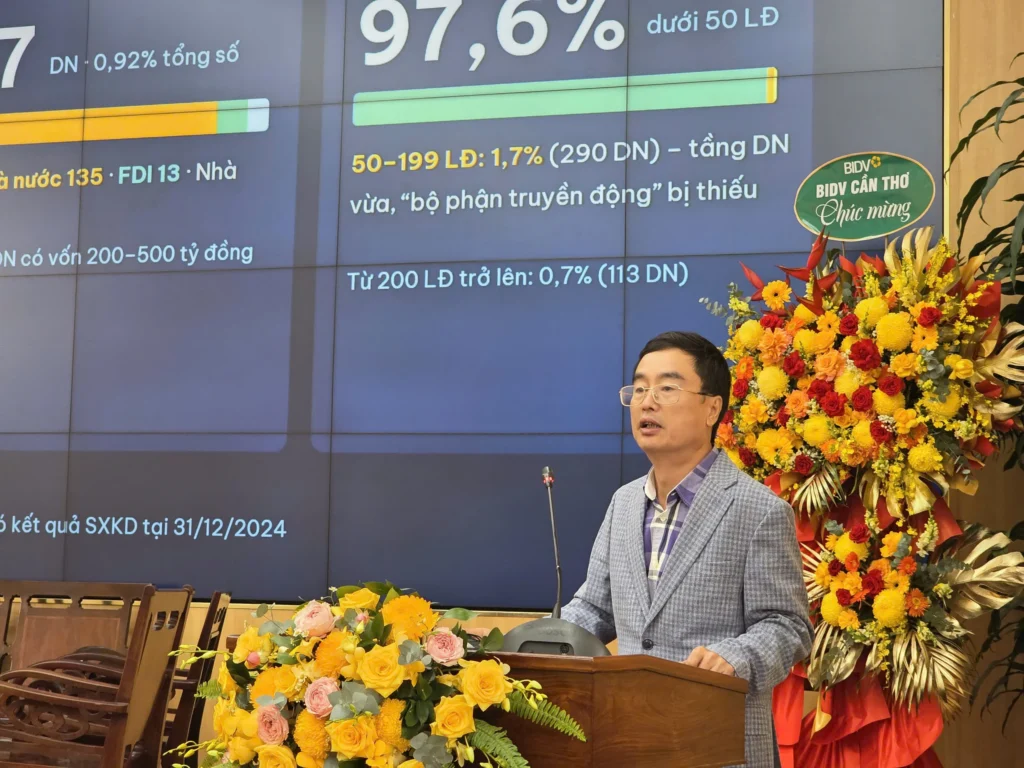
Prof. Vo Xuan Vinh delivers his presentation at the forum.
First, labor productivity and management capacity remain limited. Fixed assets per worker in the purely private sector amount to VND 213.5 million, considerably lower than in the state sector. Meanwhile, only 18.3% of the workforce has received formal training and holds relevant qualifications or certificates, highlighting the urgent need to improve human resource quality and strengthen enterprises’ capacity to adopt technology.
Second, limited access to capital and institutional implementation barriers remain significant obstacles. According to the figures presented in the paper, 69.5% of outstanding credit balances are short-term loans, while 93.5% of loans require collateral. In addition, difficulties involving land-related procedures, administrative documentation, and the business environment continue to affect enterprises’ investment and production expansion plans.
Third, value chain linkages and regional connectivity remain underdeveloped. Only 5.6% of local private enterprises have established both input and output linkages with foreign-invested enterprises (FDI). This indicates considerable room for developing domestic supplier networks, strengthening cooperation between domestic and foreign-invested businesses, and making more effective use of regional connectivity advantages across the Mekong Delta.
Fourth, climate change and green transition requirements are placing additional pressure on businesses. Riverbank erosion, saltwater intrusion, and environmental fluctuations are affecting raw material supply areas, production activities, and supply chains. Notably, international trade agreements increasingly emphasize environmental protection, sustainable development, and carbon emission reduction. To ensure their export products meet international market requirements, Prof. Vo Xuan Vinh emphasized that enterprises need to strengthen innovation and adopt new technologies to comply with increasingly stringent industry standards.
Development Orientations for the Private Sector in 2026 – 2030
In response to these challenges, Prof. Vo Xuan Vinh emphasized the need to renew the approach to private sector development in line with Resolution No. 68-NQ/TW. This requires shifting from merely supporting enterprises in maintaining their operations toward creating a favorable business environment that enables them to grow, innovate, and improve productivity.
To achieve the target of 40,000 enterprises and position Can Tho as a growth pole of the Mekong Delta, the city needs to prioritize high-value-added industries that can strengthen its economic foundation and reinforce its position as a central gateway to the region. Four promising industry clusters have been identified:
- Deep Processing of Agricultural and Aquatic Products: Promoting the application of technology in preservation, processing, product traceability, and brand development.
- Multimodal Logistics: Strengthening connectivity among inland waterway and road transportation, cold storage systems, seaports, and airports, thereby enhancing the city’s role as a regional logistics hub.
- Digital Technology, Semiconductors, and Artificial Intelligence (AI): Promoting technological applications in precision agriculture, e-commerce, business management, and emerging technology sectors.
- High-Quality Services: Developing education, healthcare, finance, and management consulting services to meet the needs of businesses and residents throughout the Mekong Delta.
To achieve these growth objectives, Can Tho must prioritize investment in high-quality human resource development and strengthen its role as a regional hub for training and supplying skilled labor across the Mekong Delta.
The presentation also proposed six key groups of solutions: supporting enterprises in progressively upgrading productivity; developing local supplier programs; building a facilitative government supported by interconnected data systems; expanding access to credit based on cash flow and business plans; co-financing technology training and human resource development; and promoting green transition, circular economy models, and the effective utilization of agricultural by-products.
Highlights from the Forump:

| The Institute of Business Research (IBR) is a pioneering institution in internationally oriented academic research and serves as a strategic consulting center, leading numerous research initiatives with significant policy impact. Through its research and consulting activities, IBR makes practical contributions to the socio-economic development of local communities and the country as a whole. |
Article by: Nhu Y – Institute of Business Research

